15 Nov 2020
August 5, 2021 update: Since publishing this post, Turbo was released. While the method described here for building a live search interface with Stimulus still works just fine, if you’re using Stimulus, you might be interested in the other half of Hotwire on the web. In August of 2021, I published a post describing how to build the same interface described here with hotwire-rails, instead of just Stimulus.
Today we’re going to build a search form that instantly filters results using Ruby on Rails and Stimulus, a “modest” JavaScript framework designed to add small bits of interactivity without a lot of heavy lifting.
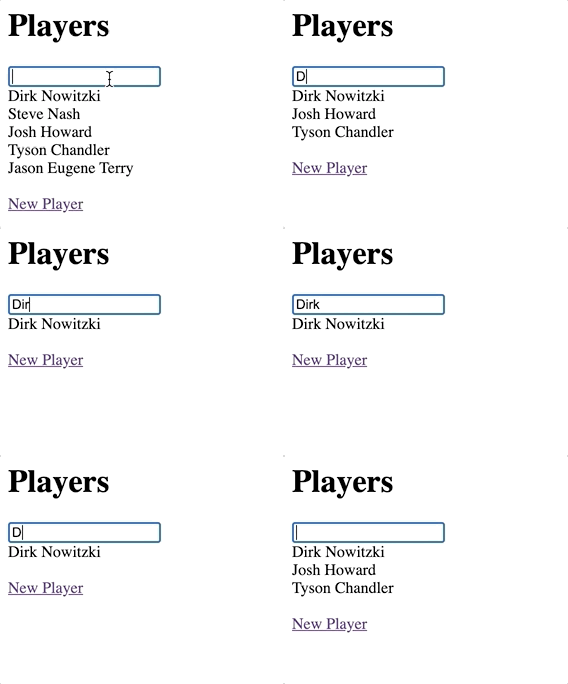
When we’re finished, we’ll have a list of Players that users can search by name. As they type in the search box, we’ll make a request to the server for players that match and display the results on the frontend (almost) instantly. Here’s what the end result will look like:
Read the rest
15-minute read
07 Nov 2020
If you use Ruby on Rails, you’ve probably heard of Stimulus, a “modest” JavaScript framework for sprinkling in small bits of JavaScript to your mostly-HTML front-end. Instead of reaching for the monster JavaScript frameworks that have become very popular in recent years, Stimulus gives you the tools to add just enough interactivity while relying on plain-old Rails and HTML as often as possible.
To show you the power and simplicity of Stimulus we’re going to build a simple Stimulus-powered implementation of a commenting form. When we’re finished we’ll have a comment form that skips a page turn and neatly renders our new comments as we create them, without jQuery or JS partials — just a little bit of Stimulus-flavored JavaScript and HTML.
Read the rest
21-minute read
28 Sep 2020
Below you’ll find a lightly edited version of an internal update I sent to everyone at CareerPlug after the completing our first product cycle, modeled on Basecamp’s Shape Up method.
Since the target audience for these updates is the company first, I’ll add inline commentary and footnotes as needed to add context for readers that aren’t intimately familiar with CareerPlug’s internal workings.
My intent in sharing these kinds of internal documents is to help demystify the inner workings of product organizations — or at least the one product organization I can demystify.
As an introduction to our org, CareerPlug has ~50 employees in total, with a product team of 13 people. Today, our product team is made of up two UX designers, eight engineers, and two QA engineers, plus me.
Our core product, launched in 2012, is an Applicant Tracking System (ATS) used by more than 12,000 businesses in the United States and Canada. Our core clients are brick-and-mortar businesses (think retail, restaurants, and home services) with limited professional HR resources. Our ATS covers everything from distributing job postings to a variety of online job boards (think Indeed) through pre-hire assessments, interviews, offer letters, and background checks. It is a big, fairly complex piece of software, but we do our best to make the end user experience simple.
Let’s dig in. -David
Read the rest
13-minute read